Storyteller Art

A series of short stories about growing up in the Mississippi Delta
illustrated with contemporary art by the author.


home

illustrated
stories

artist
bio

art
criticism

contemporary
art

artists & writers
resource page

 
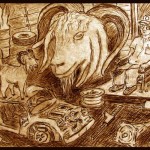
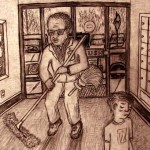
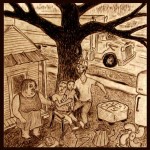
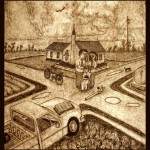
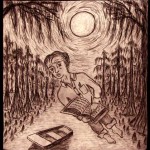
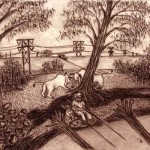
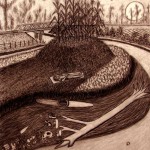
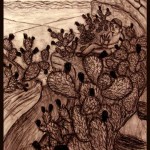
 Paw Paw's Goats charcoal illustration
 

Paw Paw's Goats

If God started talking to someone from the Mississippi Delta, wouldn't they be black? The thought keeps me leaning toward some sort of sanity, but I'm not entirely sure.

My grandfather's goat pen was all that separated our house from the Greenville sewage works. The city built the sewage works on land they condemned by imminent domain over the wishes of my grandfather, the owner.  The city had promised that it wouldn't stink, but it always did.

The goat pen was in a low narrow pasture that started at the welding shop behind his house and ran behind our house to where the bayou started.  The pasture was actually an arm of the old bayou back when the water table was higher.  And when it rained heavily.

Mostly it was dry.  In fact it got drier every year as I was growing up.  Bone dry.

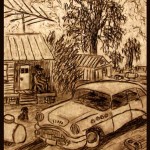
My grandfather let the old goats keep breeding, and they ate up every scrap of green, everything but the old wrecked cars and engine blocks, the rusted-out tractors and that kind of stuff.  The entire goat pen was dead, brown and rusted. 

There were a few saplings here and there, but eventually the billy goats worked these down to stumps by using them to sharpen their horns.  When the stumps were gone, there was nothing to hide the backside of the sewage works.

On the days when my grandfather burned shop trash in the rusted 55-gallon drums, it really looked like hell on earth.  Smelled like it too.  There were plastics of all description from all the junk in the shop, so the smoke was black and burned the eyes with all its toxins. 

Something else suddenly occurs to me about the sewage works, something ironic, something I never even considered while I was growing up:

We all had septic tanks out there. Or open cesspools.  My grandfather's house, his brother's, the houses and trailers of all their grown-up kids too, including the house we lived in.  All of my relative's homes had septic tanks or open cesspools and were not connected to the city sewage works. 

Except for 3 or 4 trailers in the field on the other side of the ditch, all our backyards or side yards butted up against the chain link fence of the sewage works.  From the highway, you could see a drunken row of houses and trailers that ended at the levee, and if it was February and the weeds were dead, you could see the brown pools scattered along this chain-link fence, looking like spills or accidents that had been fenced out.

None of my relatives paid city taxes of course, because we were out in the county, and so there was no legal grounds to demand that we be hooked to the system, but that didn't change the fact that the city had forcibly taken half the family land and built an industrial-sized sewage works on it that didn't include any of us. 

The chainlink fence was what I always hated the most, after the constant flatulent smell of course.  It could never contain or hide this giant mess the city had built by force right up next to our houses.  It was a joke. 

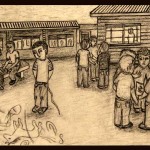
At school, I was constantly picked on for how I smelled just because they could all see the sewage plant from the highway.  I began to bath compulsively.  I hated that flimsy little fence more than the concrete ponds of excrement behind it.

My father was exposed to Hepatitis when I was about eleven or twelve and was sick for some time. I suspect a lot of the rusted iron and trucks and farm equipment he welded on could have been the source, especially those down at the low end of the goat pen where the water backed up.  His fat fingers always had gouges knocked out of them, and the mercurochrome can't get to a deep puncture.

My father was a welder for a pipeline company.  He drank about five or six or so beers in the afternoon after work.  He drank through dinner, and then he went to bed right after whether it was still daylight or not.  He always went to bed by seven at the latest and was up at the crack of dawn for work.  He had grown up farming on rented lands in rented houses with all my great uncles (my grandfather's 13 brothers), most of whom had grown up tenant farming the Delta and the bottom lands of Yalobusha county before most of Mississippi had electricity. 

After my father got off work, he did some welding in Paw Paw's shop. The shop was a cluster of sheds and makeshift garages behind my grandfather's house next door. My grandfather and uncles parted-out wrecks and did repair jobs ranging from swapping out engines and transmissions to paint and body work to rebuilding an outboard motor in a 55-gallon drum.  They would already be drinking when my father got there, and he would be drinking too, from the drive home.

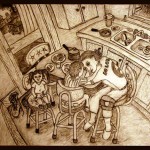
Dinnertime was over two hours later, so my father would be good and beered up by then, and his eyes would be glazed over.  He would stare into the distance while my mother tried to talk to him. 

Eventually she would nag and yell, and then suddenly he would yell back, and then they would yell at each other until he had slammed out the back door and walked out to lean on his truck and stare at the highway.

The drinking became worse after my father had the spell with Hepatitis.  He didn't drink more, or that much more, as best I can recall.  It just made him more glazed over, more...

See, that's what scares me.  I just sit down and start listing basic things about growing up, and it sounds like a story you would write if you were trying to capture the essence of the Delta.  It didn't seem to have that kind of significance at the time.  It just seemed gross, just a whole load of shit I had to put up with.  But now it all seems to be filled with archetypes and even calculated stereotypes, as if the biographer were just trying to fabricate something from a checklist.

I imagine seeing God and learning He is a black man. 

"God," I say, "Did you really do all that stuff or was I just crazy?"

"Yep" He says.

"But I'm not black," I say.

"Nobody's perfect," He says.


home

illustrated
stories

artist
bio

art
criticism

contemporary
art

artists & writers
resource page

online resource pages:

literary
magazines

literary
journals

literary
awards

independent
publishers

writer's
resources

short stories
online

art online

folk art online

artist websites

atlanta art

artist's resources

The ONLINE RESOURCE PAGES are relevant Internet content organized for browsing and networking purposes only.
Use at your own discretion and risk. We have not evaluated any claims or used any of the paid services, workshops, etc.
Our comments are based on subjective impressions of how the website presented its content and its apparent relevance compared to other pages. Our comments are not an endorsement. We are not liable for external content. Please email comments and problems with links to content@mosaicartsupply.com

 Website stories and art copyright 2008 JEM.  Not to be reproduced without express permission. Abstract Expressionism.

return to top

sitemap